
Contact Lens Services
Premier Eye Center fits and prescribes contact lenses for patients throughout Prescott and the surrounding area — including patients who’ve been told by another eye doctor that they can’t wear contacts. Our goal with every fit is the same: lenses that are clear, healthy, and comfortable enough that you forget you’re wearing them.

Schedule An Appointment With Our Contact Lens Specialists
We offer great rebates on year supply of contact lenses!
There’s no set age at which someone is too young or too old for contacts. And there’s no prescription so complicated that it’s not worth a conversation. Dry eyes, astigmatism, extremely high prescriptions, keratoconus, presbyopia, past eye surgery — we fit patients with all of these, every week, using lens designs that simply didn’t exist when many people were first told “contacts aren’t for you.”

Contacts in Prescott’s Climate
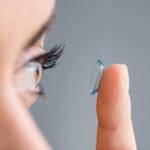 Prescott’s dry, high-altitude air is hard on contact lens wearers — lenses dehydrate faster here, and marginal dry eye that wouldn’t bother you at sea level can make afternoon lens wear miserable. It’s a real factor in how we choose materials and modalities for local patients, and it’s part of why scleral lenses, with their built-in saline reservoir, do so well here: many of our scleral patients wear their lenses comfortably all day, even in our dry high-altitude Prescott air. If your current contacts quit on you by 3 PM, that’s a fitting problem worth solving, not something to live with.
Who Can Wear Contacts (More People Than You’d Think)
Contact lens technology has moved fast, and a lot of the “you’re not a candidate” verdicts people carry around are ten or twenty years out of date. Patients we routinely fit include:
- Dry eye patients — with breathable materials, daily disposables, and in tougher cases, scleral lenses that hold a reservoir of saline against the eye all day.
- Astigmatism — toric soft lenses and rigid designs handle most prescriptions without drama.
- Presbyopia (over 40 and your “arms got too short”) — multifocal, bifocal, and monovision options mean reading glasses aren’t the only answer.
- Keratoconus and irregular corneas — including corneas shaped by past LASIK or RK surgery, where glasses can’t fully correct vision. These are exactly the cases specialty lenses were built for.
- Very high prescriptions — where glasses get thick, heavy, and distort peripheral vision.
One of our scleral lens patients — a woman with a decades-old cornea transplant — put it this way after her fitting: “Seeing that good out of my left eye yesterday after being blind in it for over 30 years is truly a blessing I don’t take lightly.”
Lens Types We Fit
We fit all types, brands, and modalities. In practice, that breaks down into:
- Daily disposables. A fresh, sterile pair every morning, nothing to clean, nothing to store. The lowest-maintenance and most hygienic way to wear soft lenses, and often the right call for dry eye patients and part-time wearers.
- Silicone hydrogel soft lenses. Modern soft lens materials that transmit far more oxygen to the cornea than older hydrogels — “breathable” is the industry word, and it’s earned.
- Toric lenses for astigmatism. Soft or rigid designs that correct the irregular focus astigmatism causes.
- Multifocal, bifocal, and monovision. Several different strategies for presbyopia. Which one works best depends on your prescription, your pupil size, and honestly, your daily habits — which is why the fitting conversation matters as much as the measurement.
- Rigid gas permeable (RGP). Small, durable rigid lenses that deliver exceptionally crisp optics. Today’s materials transmit oxygen at rates higher than many soft lenses.
- Orthokeratology (ortho-k). Lenses are rigid gas-permeable contact lenses worn overnight that temporarily reshape the cornea. You take them out in the morning and can see clearly during the day without glasses or daytime contacts.
- SynergEYES hybrid lenses. A rigid center for crisp RGP-quality vision, bonded to a soft skirt for soft-lens comfort.
- Scleral lenses. Large rigid lenses that vault over the entire cornea and rest on the white of the eye, holding a cushion of sterile saline against the corneal surface. For keratoconus, post-surgical corneas, and severe dry eye, they can be genuinely life-changing — we’ve helped patients avoid corneal transplants because their vision and comfort in sclerals were that good.
What to Expect at Your Contact Lens Exam and Fitting
A contact lens fitting isn’t a glasses exam with a different prescription pad. Contacts sit directly on the living surface of your eye, so the lens has to match your eye’s shape — not just your prescription.
Your visit starts with a comprehensive look at your eye health, because a lens on an unhealthy eye is a bad idea no matter how good the optics are. From there, your doctor measures the front surface of the eye. For standard fits, that means assessing corneal curvature; for specialty and hard-to-fit cases, we map the cornea in detail with our corneal topographer and analyze the lens-to-eye relationship under a medical microscope. Adjustments to specialty lenses are made in microns — for reference, one inch is 25,400 microns.
Then comes the part most offices can’t do: because Premier Eye Center maintains a large inventory of diagnostic contact lenses, most patients leave wearing new contacts the same day as their exam and fitting. No waiting a week for trial lenses to ship.
If you’re new to contacts, we don’t hand you a box and wish you luck. You’ll get one-on-one instruction on inserting, removing, and caring for your lenses before you walk out.
Specialty fits run deeper. A typical scleral lens fitting takes three to four visits ranging from 30 minutes to two hours, because the lens settles on the eye over time and the doctor refines the fit as it does.
Same-Day Contacts
Worth its own callout because it’s a real differentiator: our diagnostic lens inventory means the gap between “I want to try contacts” and “I’m wearing contacts” is usually one appointment. For updated prescriptions and common lens types, you leave seeing the difference — not waiting on a shipment.
Insurance and Medically Necessary Lenses
Standard contact lenses typically fall under vision plans. But specialty lenses are a different animal: because scleral and other specialty designs function as medical devices treating a condition — not just correcting eyesight — they’re often billed differently than standard contact lenses and are often covered by medical insurance as “medically necessary”. Our insurance specialists will happily review your plan coverage with you before you commit to anything.
