
Advanced Diagnostic Testing at Premier Eye Center
Not every eye problem is obvious.
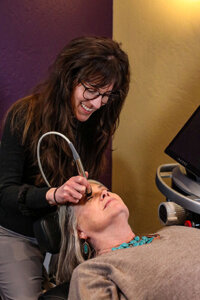 When a routine exam turns up something that needs a closer look, Premier Eye Center has the diagnostic tools to follow through — right in the same office. Advanced imaging can detect early signs of glaucoma, macular degeneration, and diabetic changes before they affect your vision. Electrodiagnostic testing evaluates the visual pathway for neurological conditions.
Corneal mapping supports contact lens fitting and keratoconus monitoring. Peripheral vision screening is included with every comprehensive exam at no extra charge.
Whatever the equipment, your doctor explains the results before you leave.
Click Here & Schedule An Appointment Today
Common Questions About Comprehensive Eye Exams
A comprehensive eye exam covers a lot of ground — refraction, binocular vision testing, tonometry, a retinal exam, and a screening visual field. That’s where we start for every patient. When findings from that exam raise a question — a suspicious optic nerve, unusual corneal curvature, abnormal pressure readings, early retinal changes — that’s when we turn to the instruments below.
These tools produce data that can’t be gathered with a slit lamp and a focusing lens alone. Some of them measure tissue in micrometers. Some capture electrical responses in your retina and visual cortex. Most are completely painless and take just a few minutes.
No. You can schedule directly with Premier Eye Center. If your exam or a specific symptom warrants advanced testing, your doctor will order it during your visit.
Yes. Our doctors review and explain diagnostic results during your appointment. You won’t leave wondering what the images showed or what the numbers mean.
Each test is relatively brief — most take two to five minutes. If your exam includes multiple diagnostic procedures, the overall appointment may run longer than a standard exam. Our front desk can give you a realistic time estimate when you schedule.
Most of the tests described on this page do not require dilation. OCT imaging, visual field testing, corneal topography, electrodiagnostic testing, and pachymetry are all performed without dilating drops. Your doctor will let you know in advance if dilation is needed for any part of your exam.
Most advanced diagnostic tests are ordered when clinically indicated and are billed to medical insurance, not vision plans. The Humphrey Visual Field screening is included in every comprehensive exam at no additional charge. If advanced testing is recommended during your visit, your doctor will discuss what’s involved and how it’s billed. We accept most major medical insurance plans as well as vision plans — see our insurance page for details.
